

You pick up your phone to check the weather. Twenty minutes later you're deep in someone's vacation photos, and you still don't know if you need a jacket. If that sounds familiar, you're not alone, and it isn't a willpower problem. Our phones are designed to hold our attention, and they're very good at it.
Let’s work on reducing screen time.
This November, I'm inviting you to try something different. No Phone November isn't about giving up your phone. It's a month of small, doable changes that help you notice how you use it and choose where your attention goes. Many people find that the time they get back goes to the things they say matter most: sleep, focus, rest, and the people they love.
Here's how to play along at home, with a simple point system to keep it fun.
Start where you are.
Before changing anything, get curious about your starting point. During the last week of October, use your phone as you normally would. On November 1, look up your daily average screen time for that week:
iPhone: Settings > Screen Time > See All App & Website Activity > Week
Android: Settings > Digital Well being & parental controls
Write that number down. It's your baseline, and the only number you're measured against. It doesn't matter whether it's two hours or eight. What matters is how it changes. Try to look at it with curiosity rather than judgment. It's information, not a grade.
For a fuller picture, try the free Digital Dependence Index from the Mind, Machine, and Meaning Institute. It takes about four minutes and looks at your relationship with technology, not just your hours. Take it again at the end of November to see what's changed.
Make your phone a little less sticky
You don't have to rely on willpower alone. A few one-time changes make your phone less tempting, so the healthier choice becomes the easier one.
Turn on greyscale. Bright colors make apps more appealing. A grey screen is surprisingly less fun to scroll. On iPhone: Settings > Accessibility > Display & Text Size > Color Filters > Grayscale. On Android, look under Accessibility or Digital Well being's Bedtime mode.
Turn off non-essential notifications. Every buzz pulls you back in. Keep calls and messages from people, and silence the rest.
Give your phone a parking spot. A lockbox, a drawer, or a basket by the door creates a pause between the urge and the scroll.
Simplify your home screen. Move tempting apps off the first screen or into a folder, so opening them takes a conscious choice.
Delete a social media app or two. You can still check in from a web browser, which adds just enough friction to make you ask, "Do I really want to?"
Build small daily habits
Setup changes make things easier. Daily habits are where the real change happens. Pick one or two to start, and add more as they feel natural.
Charge your phone outside the bedroom. An inexpensive alarm clock means your phone doesn't need to be the last thing you see at night or the first thing you reach for in the morning.
Keep meals phone-free. Whether you eat alone or with others, give the meal your full attention.
Protect your first 30 minutes. Start the day with your own thoughts before anyone else's news, emails, or opinions.
Take a lockbox hour. Put your phone away for one full hour and notice what you do with the time.
Swap in something real. When the urge to scroll hits, try a short walk, a few pages of a book, or calling someone instead of texting them.
Keep score (if you like)
A little friendly competition with yourself can keep things fun. Keep a tally on paper or in a notebook, and check your screen time at the end of each week. Better yet, invite a friend, partner, or family member to play along with you.
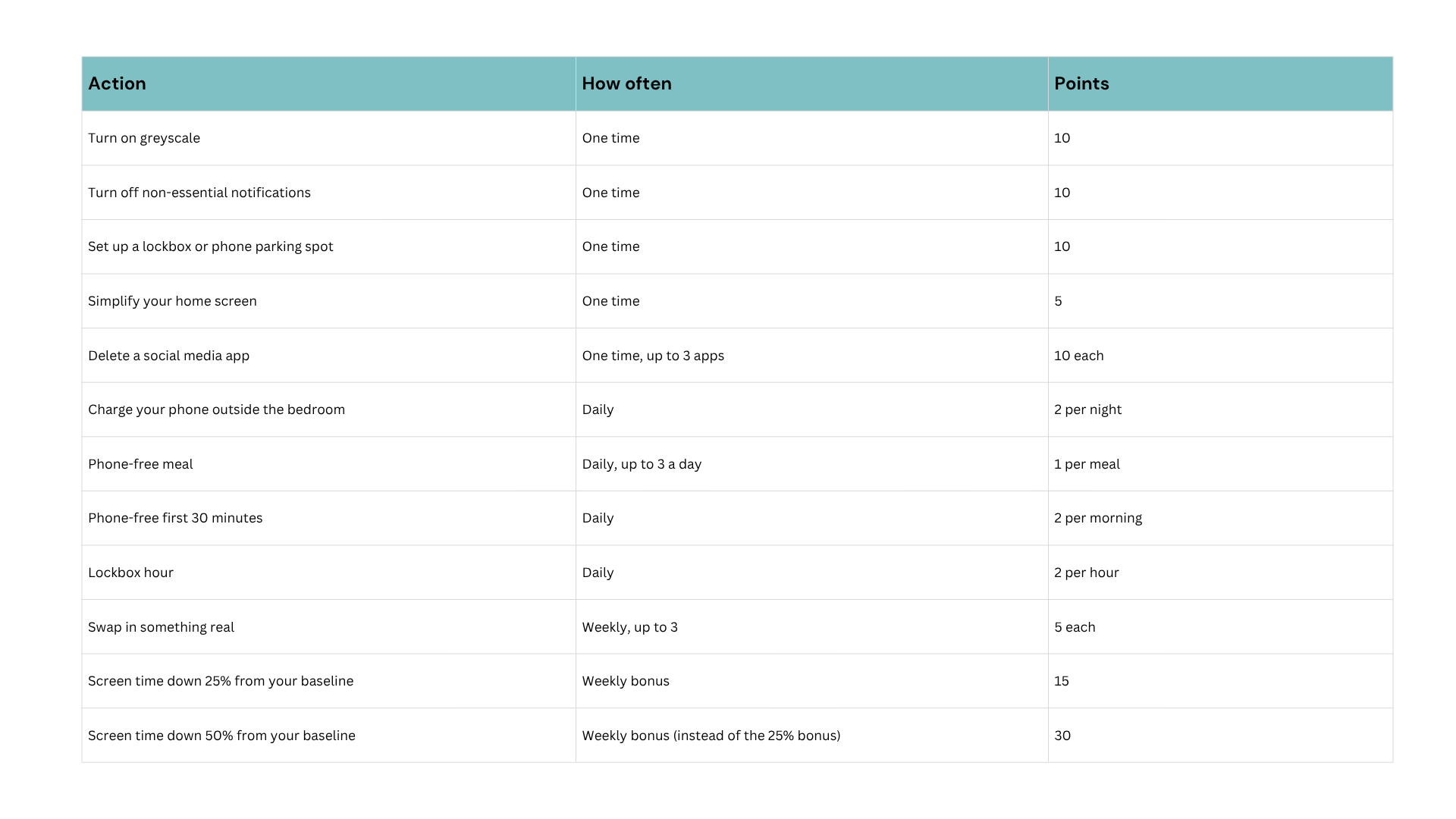
By November 30, see where you land: Bronze at 75 points, Silver at 175, and Gold at 300. Celebrate whatever you reach. A screen-free afternoon doing something you love is a fitting reward.
Resources
Mind, Machine, and Meaning Institute was founded by UC Berkeley faculty to help people "stay in command of their minds in the age of AI." Alongside the Digital Dependence Index, it offers free self-assessments for stress, sleep, attention, loneliness, and more, with feedback on what to start or stop doing. In early research with Berkeley students, reducing digital dependence went along with less stress, anxiety, and loneliness. The institute notes that these findings are still preliminary.
Be gentle with yourself
Some days you'll scroll longer than you meant to. That's not failure. It's a chance to notice what pulled you in. Were you bored, tired, lonely, or avoiding something? That moment of noticing is where real change starts.
By the end of the month, I hope you find a few extra hours, a little more calm, and a clearer sense of what you want your attention to go toward.
Take care of you!
Amy Jo